






Cloud Hosted PBX Systems, On-premise PBX Resources, Voice over Internet Protocol (VoIP) Resources
4 Types of Office Phone Systems for Small Business in South Africa
Finding the right business telephone system for your small business is easier said than done. With so many options available, it can be difficult to know where to start or what you actually need.
Below, we cover four types of office phone systems for small businesses in South Africa, from flexible cloud-hosted solutions that work over your internet connection to traditional on-premise systems built for reliability. Each option is broken down by how it works, who it suits, and what it costs, so you can make a confident, informed decision.
Keep reading to compare your options, then contact United Telecoms for expert advice tailored to your business.
Key Takeaways
- Cloud PBX delivers enterprise-grade features such as an auto-attendant and call recording for R50 per extension, with no hardware to maintain.
- On-premise PABX puts you in full control of your phone system, with outright purchase from R4,000 or flexible rental terms available.
- Wireless DECT and Wi-Fi systems give mobile teams the freedom to roam your premises, with handsets starting from R700 per month.
- VoIP phone systems can reduce your monthly calling costs by 40 to 60 per cent compared to traditional Telkom landlines.
- Most business phone systems operate on month-to-month contracts, so you can scale up or down as your business changes without penalty.
- You can keep your existing 011 or 021 number when switching to any of the four systems covered in this guide.
Table of Contents
4 Types of Office Phone Systems for Small Business in South Africa
How Much Does an Office Phone System for a Small Business Cost
Top 4 Office Phone Systems for Small Business in South Africa
1. Cloud PBX: A Feature-rich Hosted Phone System
2. On-Premise PABX: A Reliable, Hardware-Based Phone System
3. Wireless Phone System: Cord-Free Communication for Mobile Teams
4. VoIP Phone System: Internet-Based Calling for Any Business
What is the Best Phone System for Small Business
Final Thoughts on the Best Office Phone Systems for Small Business
How Much Does an Office Phone System for a Small Business Cost?
The cost of a small business phone system in South Africa depends on the type of solution you choose, how many users you need to support, and whether you prefer to buy or rent your equipment.
The good news is that modern phone systems are far more affordable than most business owners expect, with options starting from as little as R65 per extension per month.
Here is a quick overview of what you can expect to pay:
| Solution | Starting Price (excl. VAT) |
|---|---|
| Cloud PBX | From R50 per extension per month |
| On-Premise PABX | From R4,000 outright or rental available |
| Wireless Phone System | From R600 per handset or R95 per month rental |
| VoIP Packages | From R100 per month |
| Unlimited VoIP Calling | From R300 per user per month |
Most providers offer month-to-month contracts, so you are not locked into a long-term arrangement. You can scale your system up or down as your business changes.
Browse the four solutions below to compare features and pricing, then contact United Telecoms for a quote tailored to your exact needs.
Top 4 Office Phone System Options for Small Businesses in South Africa
Every small business manages communications in its own way.
The right business phone system for you depends on your team, your budget, and how your customers expect to reach you.
Below, we compare four proven office phone systems to help you find your perfect match.
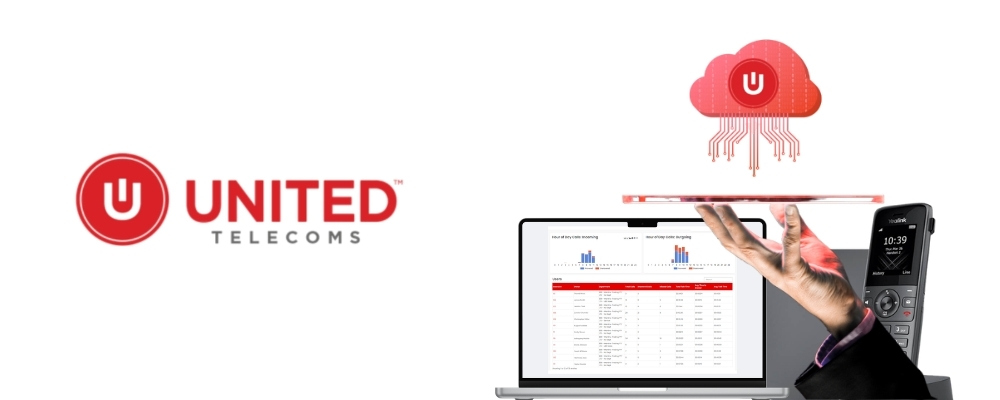
1. Cloud PBX: A Feature-rich Hosted Phone System
A cloud PBX replaces your traditional office phone system with a fully hosted solution delivered over the internet. Your provider manages everything remotely, from extensions and call routing to voicemail and auto-attendant, so there is no hardware to maintain on your side.
What makes Cloud PBX different from a traditional office phone system?
A traditional office phone system relies on physical switchboard equipment installed at your premises, which means upfront hardware costs, ongoing maintenance, and a system that can quickly become outdated.
A cloud PBX removes all of that. Everything runs in secure off-site data centres, and your team connects via any internet-enabled device, such as laptops, desktop and mobile apps. Everyone shares the same number range and phone system regardless of where they work, and updates occur automatically in the background.
Is Cloud PBX the right business phone system for your small business?
If your business is growing, has staff working across different locations, or simply needs a more professional and reliable phone system without a large upfront investment, cloud PBX is worth serious consideration.
Key features include:
- Auto-attendant: A professional virtual receptionist greets and routes every caller
- Call forwarding: Stay reachable even when you are away from your desk
- Call recording: Keep accurate records of important conversations
- Video conferencing: Face-to-face meetings built directly into your phone system
- CRM integration: Connect your phone system to your existing customer management tools
- Real-time call analytics: Monitor team performance and call activity as it happens
How much does Cloud PBX cost for a small business in South Africa?
Pricing typically starts from R50 per extension per month, depending on the features and package you choose. Most providers offer month-to-month contracts, so you can scale up or down as your business changes without being locked into a long-term agreement.
United Telecoms offers United Voice Cloud, a feature-rich cloud PBX built for South African businesses. Choose from three packages, Essential, Classic, and Pro, to match your team size and communication needs. All packages include access to the UVC softphone for desktop and mobile, plus tools such as call recording, CRM integration, and real-time analytics. You can keep your existing 011 or 021 number or choose a new one.
Ready to upgrade your business phone system? Explore United Voice Cloud today or contact our team for a personalised demo.
Looking for a deeper comparison of cloud phone systems? Read our guide to the best cloud phone systems for small businesses in South Africa.
2. On-Premise PABX: A Reliable, Hardware-Based Phone System
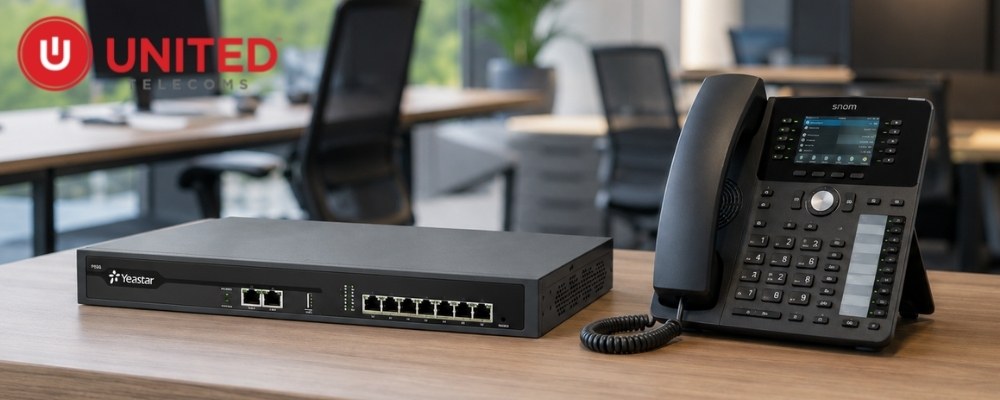
An on-premise PABX (private automatic branch exchange) is a traditional business phone system where the hardware is physically installed at your premises. Your business owns and controls the equipment directly, making it a popular choice for small businesses that prefer a dedicated, self-contained phone system.
What makes an on-premise PABX different from a hosted phone system?
Unlike a cloud PBX, which is hosted and managed off-site, an on-premise PABX puts the equipment and control directly in your hands.
Your phone system operates independently of an internet connection, which can be an advantage in environments with inconsistent connectivity. It also gives businesses with existing infrastructure a practical upgrade path.
Rather than replacing everything, a hybrid IP PABX or SIP trunking solution can connect your existing on-premises system to VoIP technology, giving you advanced features such as lower call rates, CRM integration, and increased call capacity without a full system replacement.
Is an on-premise PABX the right fit for your small business?
This solution suits businesses that want direct control over their phone system, have an existing investment in on-site hardware, or operate in environments where a cloud-based solution is not practical.
It may be the right fit if:
- Your team works from a fixed office location
- You already have a PABX system and want to modernise rather than replace it
- Your business handles high call volumes and needs a dedicated, reliable system
- You prefer owning your hardware outright rather than paying a monthly subscription fee
- Your business handles sensitive information, and you need full control over where your call data is stored and who can access it
How much does an on-premise PABX cost for a small business in South Africa?
On-premises PABX systems are available for outright purchase from around R4,000, or on a rental basis with terms ranging from 12 to 60 months to spread the cost. Pricing varies depending on the size of your team, the features required, and whether you opt for an analogue, hybrid, or IP PABX system.
United Telecoms has been supplying and installing on-premise PBX solutions for South African businesses since 1985. We provide solutions for teams of all sizes, from small offices with 2 to 5 users to larger operations with 200 or more staff. Our range includes Yeastar PABX systems, a leading brand known for reliability, scalability, and seamless integration with both analogue and IP telephony infrastructure.
Our team handles installation, configuration, and ongoing support, and can advise on hybrid or SIP trunking options if you want to modernise your existing system gradually. Contact our team today to discuss the right on-premise PABX solution for your business.
Choosing between PABX providers? Read our expert guide to the best PBX systems for small businesses in South Africa.
3. Wireless Phone System: Cord-Free Communication for Mobile Teams
A wireless phone system gives your team the freedom to move around your workplace without being tied to a desk or a network cable. Employees can make and receive business calls from anywhere on your premises using cordless handsets, Wi-Fi-enabled phones, or softphone apps on their own mobile devices.
What makes a wireless phone system different from a traditional desk phone system?
Traditional desk phones keep your team tethered to one location. Every call requires sitting at a specific desk, which limits productivity for staff who work across a warehouse, a retail floor, a medical facility, or a large office space.
A wireless phone system removes those physical boundaries. Your team stays connected to the same business number range and PBX features, but can roam freely during calls. DECT handsets use dedicated radio frequencies separate from your office Wi-Fi, while Wi-Fi phones and softphone apps connect through your existing wireless network.
Is a wireless phone system the right fit for your small business?
This solution is ideal for businesses where staff are constantly on the move.
It may be the right fit if:
- Your team works across a warehouse, factory floor or retail store
- Employees frequently move between offices, meeting rooms or shared spaces
- You want to avoid the cost and clutter of running network cables to every desk
- Your hybrid or remote staff need to take inbound and outbound calls from anywhere
Key features include: crystal clear HD audio, long battery life for full shifts, seamless roaming between base stations, and full integration with your existing PBX or cloud phone system.
How much does a wireless phone system cost for a small business in South Africa?
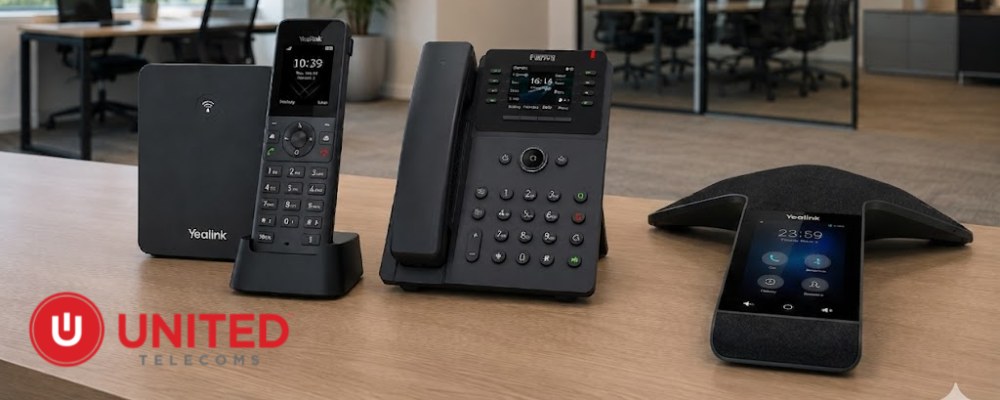
Wireless phone systems are available as outright purchases or affordable monthly rentals. DECT cordless handsets start from around R600 for a single handset with base station, or from R95 per month on rental. Multi-handset bundles for larger teams range from R1,000 to R8,000+, depending on the number of handsets and features required.
United Telecoms supplies a full range of wireless phone systems from leading brands including Yealink, Snom, Fanvil, Flyingvoice and Gigaset. We offer DECT cordless handsets for reliable coverage across large areas, Wi-Fi-enabled phones for flexible deployment, and softphone apps that turn your team’s own smartphones into business extensions. All solutions integrate seamlessly with United Voice Cloud or your existing PBX system.
Our team can assess your premises and recommend the right wireless setup for your specific environment. Contact us today to discuss a cord-free phone system for your business.
4. VoIP Phone System: Internet-Based Calling for Any Business
A VoIP (Voice over Internet Protocol) phone system delivers business calling over your internet connection instead of traditional copper phone lines.
But “VoIP” is not a single product. It is a category that includes several different components. Below is a breakdown of what you can build, depending on your budget, team size, and existing infrastructure.
What are the different components of a VoIP system?
A complete VoIP setup can include any combination of the following:
VoIP Lines (SIP Accounts) – This is the core service that gives you a business number and the ability to make and receive calls over the internet. Works with your existing internet connection.
Cloud PBX (Hosted Phone System) – Adds advanced features such as an auto-attendant, call recording, extensions, and mobile apps.
Unlimited Calling Packages – Remove per-minute charges for a fixed monthly fee. Ideal for high-volume callers.
VoIP Phones (Hardware) – Physical desk phones or cordless handsets that connect to your VoIP system.
VoIP Softphone Apps – Connects to your business phone system.
SIP Trunking – Connects your existing on-premise PBX to VoIP technology without replacing your entire system.
Is a VoIP system the right choice for your small business?
VoIP is suitable for almost any business with a reliable internet connection.
It may be the right fit if:
- You want to reduce your monthly phone bill by 40 to 60 per cent
- You need features like call recording, auto-attendant or mobile apps
- You are setting up a new office and want to avoid expensive copper lines
- You already have an on-premise PBX and want to modernise it with SIP trunking
- Your team works remotely or across multiple locations
How much does a VoIP system cost for a small business in South Africa?
VoIP pricing depends on which components you choose.
A basic VoIP line with a local number starts from around R100 per month. A full cloud PBX with extensions starts from R50 per user per month. Unlimited calling packages with free national calls start at R300 per user per month. Most providers offer month-to-month contracts with no long-term commitment.
United Telecoms offers a complete range of VoIP components, allowing you to build a system that fits your exact needs and budget. Whether you want a simple virtual landline from R135 per month, a full cloud PBX from R65 per extension, or unlimited calling from R350 per user, we have a solution. We also supply VoIP desk phones, cordless handsets, and softphone apps for desktop and mobile.
All solutions include unlimited remote support, a choice of geographic or non-geographic numbers, and the ability to keep your existing business number.
Ready to build your VoIP system? Contact our team today for expert advice and a personalised quote.
Confused by all the VoIP options? Read our expert guide to the best VoIP solutions for small businesses in South Africa.

What is the Best Type of Phone System for a Small Business?
There is no single “best” phone system for every small business. The right choice depends on your specific situation. Below are four simple steps to help you figure out what you actually need.
Step 1: Count how many people need phones
Start with the size of your team.
- 1 to 3 users – A virtual landline or basic VoIP line may be all you need. You can add more users later as you grow.
- 4 to 15 users – A cloud PBX or wireless system gives you room to scale without changing providers.
- 16+ users – An on-premise PABX or enterprise cloud PBX will handle higher call volumes and advanced routing needs.
Step 2: Assess how your team works
Where and how your staff work will determine which features matter most.
- Mostly desk-bound – Traditional desk phones or a cloud PBX with physical handsets will work well.
- Constantly moving – A wireless DECT or Wi-Fi system lets staff roam freely while on calls.
- Remote or hybrid – A cloud PBX with softphone apps for mobile and desktop is essential.
- Mixed environment – Combine a cloud PBX with both desk phones and softphone apps.
Step 3: Consider your existing infrastructure
What you already have will influence what you need to buy.
- Reliable fibre or LTE – You are ready for any VoIP solution, from a basic line to a full cloud PBX.
- Unreliable or no internet – An on-premise PABX that works independently of your connection may be the better choice.
- Existing phone hardware – You may only need SIP trunking to modernise your current system without replacing everything.
Step 4: Account for your call volume
How much your team talks will affect which pricing model makes sense.
- Low call volume – Pay-as-you-go VoIP lines or per-minute billing will keep costs low.
- High call volume – Unlimited calling packages with a fixed monthly fee will save you money.
- Inbound sales or support – Look for call recording, analytics, and queue management features.
Still not sure which phone system is right for your business?
A quick conversation with an expert can save you hours of research.
United Telecoms has been helping South African businesses choose, install, and support phone systems since 1985. Our team can assess your needs, explain your options in plain language, and recommend a solution that fits your budget.
Contact us today for no-obligation advice tailored to your small business.

Final Thoughts on the Types of Office Phone Systems for Small Business
There is no single “best” phone system for every business. The right choice depends entirely on your unique situation, how your team works, and what your customers expect.
The good news is that you now have a clear framework to make that decision.
Review the four systems covered above to compare how each one works, who it suits, and what it costs. Whether you need the flexibility of a cloud PBX, the control of an on-premise PABX, the mobility of a wireless system, or the affordability of a basic VoIP line, there is a solution built for your business.
United Telecoms has been helping South African businesses choose, install, and support their phone systems since 1985. We offer the full range of options covered in this guide, backed by local expertise and hands-on support.
Still not sure which option is the ideal fit? Contact United Telecoms today for expert advice tailored to your small business.
Got questions? Contact our experts today.
We service the following locations in South Africa
Western Cape: Cape Town, Belville, Paarl, Stellenbosch, Somerset West, Vredendal, Hout Bay, Green Point, Bloubergstrand, Durbanville, Melkbosstrand.
Eastern Cape: Port Elizabeth, Knysna, East London, George.
Kwa-Zulu Natal: Durban, Pinetown, Ladysmith, Newcastle, Ballito, Port Shepstone, Pietermaritzburg, Umhlanga, Westville, Hillcrest, Amanzimtoti.
Gauteng: Johannesburg, Vereeniging/Vaal, Sandton, Midrand, Pretoria, Centurion, Randburg, Roodepoort, Germiston, Alberton, Edenvale, Menlo Park.
Free State: Bloemfontein, Welkom, Bethlehem.
Mpumalanga: Witbank, Nelspruit.
Northern Cape: De Aar, Kimberley, Repra (Upington Area).
North West: Klerksdorp, Mafikeng.
Limpopo: Phalaborwa, Polokwane/Pietersburg.
Outside South Africa: Botswana, Zimbabwe, Swaziland, Namibia, Mozambique.
Get In Touch
Head Office
Unit 9 Cambridge Commercial Park
22 Witkoppen Road
Paulshof
Johannesburg
2056
Tel: 086 001 8500
Email: info@unitedtelecoms.net
6 Edison Way
Century City
Cape Town
Tel: 086 001 8500
Email: info@unitedtelecoms.net
12 Sookhai Place
Derby Downs Office Park
Westville
Tel: 086 001 8500
Email: info@unitedtelecoms.net
What Our Customers Say
“Once we approved the installations we were kept up to date daily with the levels of progress on our various sites and were very impressed with the final installation”
Spear Properties
We're the experts so that you don't need to be!
PBX Phone System
Beginner's Guide
Voice & Hosted PBX
Resources
PABX Relocation and
Reinstallation
PBX Phone System
Resources